

Four Fields of Action. One common Purpose.
Our four fields of action – Energy, People, Mindset, and Product – demonstrate how we structure our approach towards sustainability. They bring together initiatives from our sustainability management and connect topics such as energy, product development, collaboration and transformation.


Field of Action: Energy
Energy is the backbone of our processes. We are deeply committed to how we can use energy efficiently, strengthen supply security, and promote the expansion of renewable energy. This sets the stage for long-term corporate growth.
To us, energy transition means investing in our future by investing in our company.


Efficient usage of Energy. For a forward-looking Production.
Energy is critical to Sandler’s activities and is symbolized by the three arcs. Sandler is an energy-intensive business. However, this provides us with a number of opportunities: using energy efficiently, pushing renewables, and reducing costs as well as consumption.
Energy Issues at Sandler
Energy is at the core of our activities. To manufacture our products, we need energy. At the same time, we are committed to closely monitor our energy consumption, identify optimization opportunities, and utilize renewable energy sources. These efforts help to ensure a stable energy supply.
The Energy Field of Action: what specific measures are we taking?
- Expansion of the grid infrastructure
- Increasing the use of renewable energy from solar and wind power plants
- Coverage of heating demand
- Battery storage
- Carbon reduction plan
- Transparent energy data
- Optimizing the energy efficiency of production units

Field of Action: Product
Our range of products is diverse. The two arches symbolize our nonwovens as roll goods. Our product defines our purpose. Raw materials, operating supplies, processes, shipping, use, and recycling: we consider the entire life cycle of our nonwovens. We frequently scrutinize every single step to identify opportunities for development and optimization and to continuously improve our products.
For selected products, material homogeneity is taken into consideration. In addition, where technically and economically feasible, we assess the use of recycled materials and rrenewable raw materials such as lyocell or viscose.


Considering Circularity from the onset
Being a nonwoven fabrics manufacturer, we are intensively involved in addressing the impact of our products and the responsible use of plastics.
In doing so, we consider factors such as lifespan, recyclability, and the use of renewable raw materials to continuously refine our materials.
Sustainable Development of Products
Sandler pursues the target of reducing the carbon footprint of our products by 40% by the end of 2035 compared with the 2021 baseline. How do we do this? To this end, we calculate Product Carbon Footprints (PCFs) to provide transparency regarding emissions throughout the whole product life cycle. These calculations take into account raw and auxiliary materials, operating supplies, and transportation. A key factor is selecting suitable textile and other raw materials.
Individualized Carbon Footprint Calculation
Would you like to have your product's PCF calculated? Here's how we calculate your PCF:
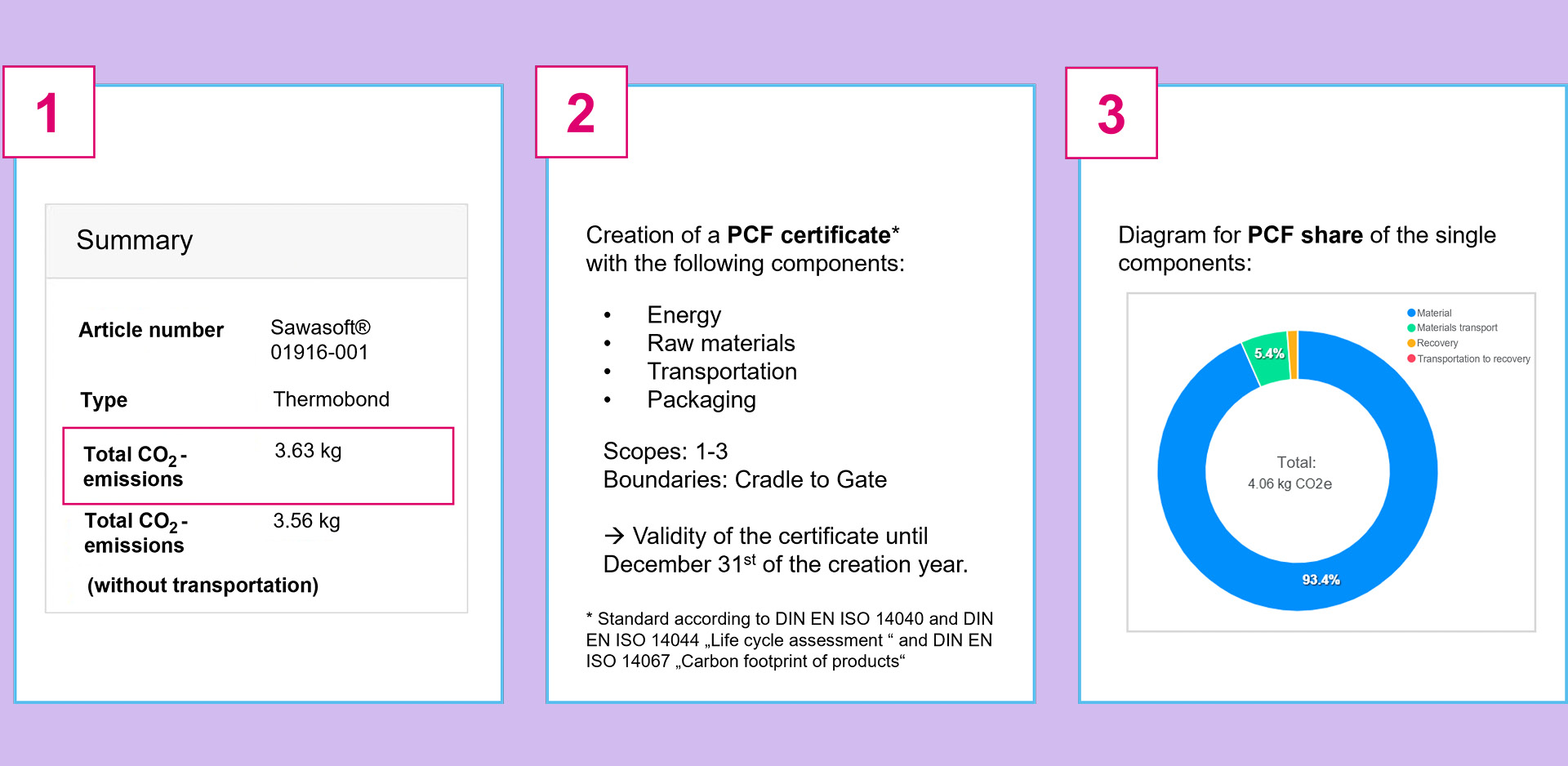
The Product Field of Action: what specific measures are we taking?
- C2C* Certification
- Internal Benchmarking
- EPD** Cerification
- Return models
- Reusable Packaging
- Definition, Assessment and Analysis of Raw Materials
- Expansion of the Partner Network
* Cradle to Cradle
**Environmental Product Declaration
Natural Fibers:
- Plant-derived fibers (Cotton, Linen, Hemp)
- Animal-derived fibers (Wool, Silk, var. Animal Hairs)
Chemical Fibers:
- Cellulosic Fibers (Viscose, Lyocell)
- Synthetic Fibers (Polyester, Polyethylene Terephtalate, Polyamide, Polyacrylic, Polypropylene
Mechanical Recycling (Tearing, Shredding):
Fabrics are torn to extract raw fibers. Sandler applies mechanical means to shred post-industrial residual materials and recycle them back into the process. Occasionally, residual materials are being torn by contractors.
Thermo-Mechanical Recycling (Regranulation):
Synthetic textiles, at large consisting of one homogenous material, can be melted down and processed into pellets, which in turn serve as raw material for new fibers.
Chemical Recycling (Depolymerization):
In a chemical process, materials are being broken down into their constituent monomers. The key processes are:
- Pyrolysis: high temperatures in the absence of oxygen thermally crack the polymer chains into smaller monomer units.
- Hydrolysis: the breaking down of synthetic condensation polymers such as PET or PA by ways of a chemical reaction.
- Solvolysis: specific solvents break down certain polymers, mostly with catalysts.
- Gasification: produces synthetic gases from plastic waste. Resulting gasses to be used by the chemical industry
Thermal Recovery (waste-to-energy):
Burning materials to generate energy
Material Recovery:
Residual materials are used downstream for other purposes, e.g. spunlace edge trims or scrap rolls turn into mops.

Field of Action: People
People must work together as a team to step by step embed sustainability within the company. We’re all in the same boat, and our diversity let’s us set sail. This is symbolized by the arc ‘People’. In all we do at Sandler, people are at the center. Only by working together as one team, we can achieve the objectives of our sustainability strategy.
“Talent wins games, but teamwork and intelligence win championships.” Michael Jordan


Diversity, Responsibility, and Collaboration
How are our employees doing? How can we protect, strengthen, or quickly restore their health? What are we doing to promote family-friendly policies, inclusion, equality, and respectful interactions? How can we contribute to education to ensure a sufficient supply of skilled workers and talents in the future?
Transformation and change can only succeed with the support of our employees, as they are the pillars of our enterprise.
People shape Change
We must take responsibility together. It is the only way to advance our sustainability strategy. The people of Sandler, in our local communities, and throughout our supply and value chains can all influence and be affected by our business operations. We are committed to dialogue, collaboration, and exchange with these stakeholders.
The People Field of Action: what specific measures are we taking?
- Ambassador Concept
- Structures for Diversity
- Specific Education and Qualifications
- Family-friendly work schedule models such as part-time shifts (part-time work)
- Transition (Onboarding and Offboarding)
- Declaration of Human Rights
- Code of Conduct for Stakeholders
- Supplier Risk Analysis
- Local Commitment


Field of Action: Mindset
We need the right mindset to understand and embrace sustainability as a business model. The “Mindset” arc shows that we must integrate and refine sustainable thinking into our day-to-day actions to bring sustainability ideas to life.
The mindset is the foundation of our transformation. Even small changes will help us progress in the long term. Each of our employees, customers, suppliers, and service providers can contribute to our sustainability strategy and get involved. Only together we can make a big difference.


Sustainability starts with the Mindset
The right mindset helps embed sustainability-related topics within the company, fosters employee engagement, contributes to the expansion of renewable energy, and strengthens our focus on the development of new products.
Through a culture of respectful and appreciative communication, we foster an understanding of understanding of sustainability-related topics.
The Mindset Field of Action: what specific measures are we taking?
- Social Media Campaigns
- Internal Awareness Campaigns
- Newsletters
- Networks of Advocates
- Communication tailored to specific Audiences
- Frequent Surveys and the Implementation of Appropriate Measures
- Stories on the Sustainability Blog
- Publication of the Sustainability Report


Learn more about the Sandler Spirit
Our fields of action demonstrate our current initiatives. However, change happens when people take responsibility, contribute ideas, and pursue one common goal. This is what signifies the Sandler Team Spirit and makes sustainability come alive in everyday.


